Alternative / 8 min read
BounceGrip vs Aymo for Multi-Model AI Teams (2026)
Compare the best Aymo alternatives: BounceGrip vs Aymo on team BYOK, multi-model comparison, shared workspaces, files, and collaboration.
If you are looking for the best Aymo alternatives, BounceGrip is a close comparison for teams that want several AI models in one shared environment. Both products are designed to reduce model switching friction, keep work inside projects and conversations, and let teams choose the right model for a task instead of committing everyone to one chatbot.
The difference is the operating model. BounceGrip is a BYOK-first workspace: owners connect provider keys, members use approved models without seeing secrets, and providers bill usage directly. Aymo is a broader multi-model platform with its own paid-plan limits, credits, managed access, and BYOK support. Aymo also supports organizations, projects, shared chats, file context, prompt reuse, and model comparison.
This BounceGrip vs Aymo comparison focuses on the team-level questions that affect a buying decision: who owns the provider relationship, how model comparison works, whether shared workspaces preserve context, how collaboration is controlled, and whether the platform fits a startup or small team that wants cost clarity without a large AI rollout.
Quick answer
What should you do?
Choose BounceGrip when team BYOK, direct provider billing, side-by-side comparison, and a focused shared workspace matter most. Choose Aymo when you want a broader multi-model platform with plan-based credits, web research, file tools, shared projects, and a larger collaboration surface.
| Criteria | BounceGrip | Aymo |
|---|---|---|
| Best fit | Founders and small teams that want a focused BYOK workspace with direct provider billing, comparison, shared prompts and files, and visible usage context. | Individuals and teams that want a broad multi-model AI platform with plan-based credits, shared projects, file tools, web search, and collaboration features. |
| Team-level BYOK | Workspace owners connect provider keys once. Members use approved models without seeing credentials, and the provider bills the model usage directly. | Aymo supports BYOK on paid plans and documents personal, shared, and team-level key isolation as an upcoming control. Confirm the current workspace-key behavior during a pilot. |
| Multi-model comparison | Run one prompt across up to four enabled models, compare responses side by side, and choose the quality-to-cost fit for the task. | Aymo has Compare Mode for sending the same prompt to multiple models and reviewing responses side by side, plus instant model switching inside chats. |
| Shared workspaces | Projects, shared prompts, files, conversations, saved outputs, and team access stay in one workspace owned by the team. | Organizations separate members, settings, files, projects, chats, prompt libraries, and permissions. Shared workspaces depend on the subscribed plan. |
| Collaboration | Share prompts, project context, outputs, and model access while keeping provider credentials private from members. | Shared chats and projects support Viewer, Writer, Manager, and Owner access patterns, with invited members and organization-level collaboration. |
| Model catalog | Connect OpenAI, Anthropic, Gemini, OpenRouter, DeepSeek, Kimi, Qwen, MiniMax, GLM, xAI, and Meta providers as enabled by the owner. | Aymo offers plan-based access to GPT, Claude, Gemini, DeepSeek, Grok, Qwen, Mistral, LLaMA, and other models, plus connected BYOK providers. |
| Prompts and team assets | Shared prompts are part of the team workflow, with project files and saved outputs kept close to the work. | Aymo has a Prompt Library for reusable prompts. Its broader Team Library for shared prompts, templates, documents, and workflows is documented as coming soon. |
| Files and context | Attach supported text, PDF, Word, CSV, and JSON files to project context and reuse them across team work. | File uploads, file context, PDF and document analysis, spreadsheets, code files, web search, and deep research vary by plan and feature availability. |
| Cost model | $10 per seat per month for Teams. Connected providers bill model usage directly, and BounceGrip adds no token markup. | Aymo subscriptions include message and credit limits. BYOK shifts model requests to connected provider accounts, while managed use follows Aymo plan limits and credits. |
| Governance | Owners control keys, approved models, team members, shared context, and usage reporting without exposing provider secrets. | Aymo provides organization members, roles, project permissions, plan-based seats, and model access controls, with more granular model and billing controls documented as upcoming. |
| Best reason to choose | You want a simple, provider-owned cost model and a comparison-first workflow for a startup or small team. | You want a larger all-in-one AI product with managed credits, research tools, broad model access, and a growing collaboration layer. |
The short answer
Choose Aymo when your team wants one broad AI environment for chat, model switching, files, web research, projects, shared conversations, and plan-based access to many models. Aymo is designed for individuals and teams, and its organization model gives administrators a place to manage members, projects, files, roles, and workspaces.
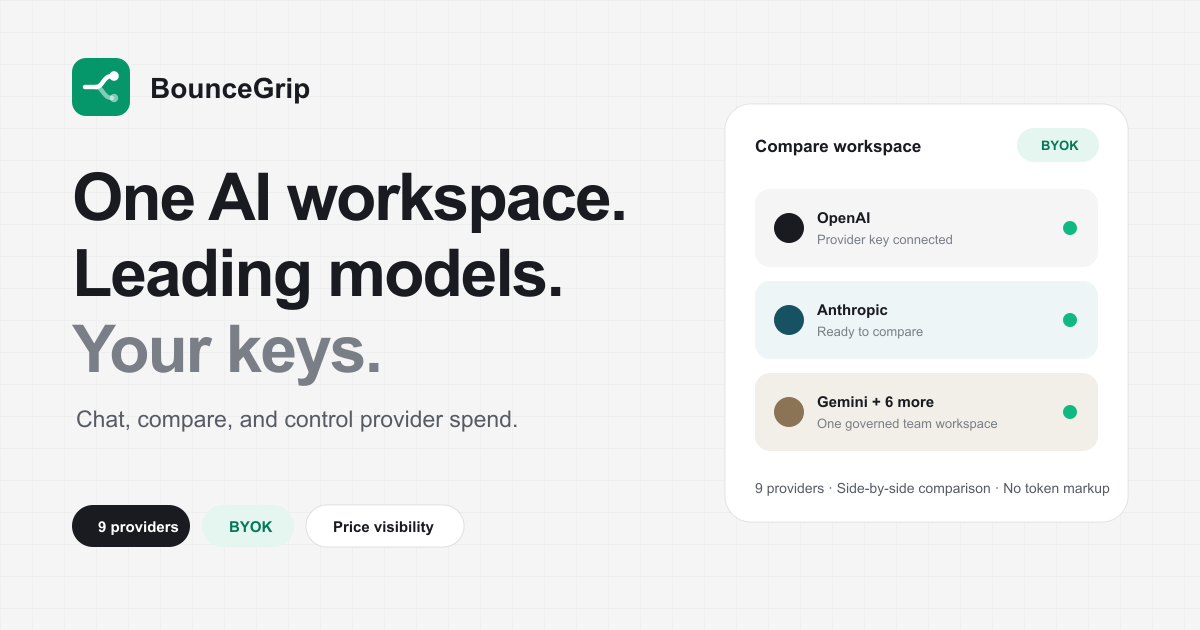
Choose BounceGrip when the team-level provider relationship matters as much as the chat interface. BounceGrip keeps BYOK at the center: the owner connects provider accounts, the team uses approved models, and the underlying model bill stays with the provider. The workspace fee is separate, and the product is built around comparing outputs before a model becomes a default.
The distinction is not that one product has models and the other does not. Both do. The distinction is whether you want a managed multi-model product with credits and plan limits, or a focused team workspace that keeps provider billing and model choice close to the people doing the work.
Team-level BYOK is the first decision
Aymo supports BYOK on its Business plan and documents connections for OpenAI, Anthropic, Gemini, Mistral, Perplexity, Grok, and Novita AI. Its documentation says BYOK models work in chats, file analysis, code generation, multi-model comparison, and thread collaboration. That makes Aymo a real option for a team that wants to bring existing provider access into a wider AI platform.
The important qualification is key scope. Aymo documents personal, shared, and team-level key isolation as upcoming. Its current team documentation also labels several granular model and billing controls as upcoming. If a team-wide provider key with strict member isolation is non-negotiable, verify the exact behavior in the live Business workspace rather than assuming the roadmap language is already shipped.
BounceGrip is simpler to explain today. The workspace owner connects provider keys once. Members use enabled models without seeing the credentials. Provider calls are routed through the workspace, and model usage is billed by the connected providers. That is a strong fit for a founder or operator who wants one accountable place to manage keys without asking every teammate to configure a provider account.
Multi-model comparison: similar feature, different center of gravity
Aymo has a clear Compare Mode. Its documentation describes sending the same prompt to multiple AI models at once and reviewing the responses side by side. It also supports instant model switching inside a thread, so users can move between GPT, Claude, Gemini, Grok, Qwen, and other available models without starting over.
BounceGrip makes comparison the core decision loop. One prompt and context can be run across up to four enabled models, then reviewed with available cost estimates. That is designed for the moment when a team is deciding whether a faster or cheaper model is good enough for a recurring job. The output quality, model choice, and provider cost are considered together.
For an individual exploring many models, Aymo can be a convenient all-in-one interface. For a small team standardizing model choices, BounceGrip puts more emphasis on turning comparisons into repeatable operating rules: one model for routine summaries, another for sensitive drafts, and a stronger option for difficult reasoning.
Shared workspaces and collaboration
Aymo organizes team work through organizations and projects. Organizations separate members, settings, files, chats, prompt-library content, and permissions. Projects can contain related conversations and files, and Aymo documents Viewer, Writer, Manager, and Owner access patterns. Shared projects help teammates continue work without duplicating context.
BounceGrip has a smaller but direct collaboration model. The workspace contains members, projects, shared prompts, files, saved outputs, and model access. A teammate can pick up the prompt, file context, and output that another person prepared, then compare the task on a different model without reconstructing the original workflow.
Aymo may be the better fit when project roles and a wider collaboration environment are the organizing principle. BounceGrip is the better fit when the team wants the collaboration layer to stay close to model access, provider keys, and the cost of each decision.
Prompts, files, and the team knowledge layer
Aymo has a Prompt Library that supports saving, organizing, searching, filtering, and reusing prompts across threads and projects. Its documentation also describes a Team Library for shared prompts, templates, documents, and internal workflows as coming soon. That means teams can build reusable habits now, but should check which library features are available to the members and plan they are evaluating.
BounceGrip treats prompts and files as part of one team record. Shared prompts can be used with project context, supported files can be attached to the work, and useful outputs can be saved. The result is less a library of isolated prompt snippets and more a traceable workflow: input, prompt, model choice, response, and saved outcome.
Test this with a real project. Give one person a source document, another person the prompt, and a third person the task of reviewing the output. The better platform is the one where the third person can see enough context to continue the work without asking the original author to explain the hidden setup.
Cost visibility: provider billing versus credits
Aymo offers a subscription model with monthly message and credit limits. Higher model tiers consume more credits, and the plan determines the available models, messages, files, and workspace capacity. For teams that want a managed budget and a predictable product experience, that abstraction can be useful. BYOK adds a provider-account path for teams that want custom model access and provider-level control.
BounceGrip keeps the workspace subscription separate from model consumption. Teams is $10 per seat per month, and connected providers bill the actual model requests. BounceGrip can show usage by model, provider, member, and project, with cost estimates where provider rates are available. It does not replace provider invoices, but it helps teams connect a model choice to the spend it creates.
Neither model is automatically cheaper for every team. Compare the full operating cost: workspace seats, provider bills, included message or credit limits, the number of models you need, and the administrative time spent interpreting usage. Aymo is attractive when managed credits simplify rollout. BounceGrip is attractive when direct provider economics are part of the reason you are consolidating tools.
Controls and small-team fit
Aymo provides organization members, roles, shared-project permissions, plan-based seat limits, and model access controls. It is a capable starting point for a team that wants a broader product surface and expects collaboration features to grow. The roadmap language around upcoming team key isolation and granular billing controls is important for a buyer that needs strict governance today.
BounceGrip is built for the startup stage where one owner or operator needs to make the essential choices clearly. Connect the keys, approve the models, invite the team, share the prompt and project context, and review usage. It does not ask a small team to adopt an enterprise AI program before the underlying workflows are understood.
For a startup or small team, the better fit is usually the platform that matches the person who will own it after launch. If that owner wants a broad product with many tools and can manage plan limits, Aymo is worth testing. If that owner wants the provider bill, model choice, and shared workflow to stay legible, BounceGrip is the more direct fit.
The verdict: choosing an Aymo alternative
Aymo is a strong option for teams that want a broad multi-model platform with organizations, projects, files, research tools, collaboration, plan-based credits, and a growing set of team controls. Its rebrand from Geeky.chat reflects that broader workspace direction, so use the current Aymo name in procurement, documentation, and internal training.
BounceGrip is the stronger alternative when team BYOK and direct provider billing are the deciding requirements. It gives a small team one place to compare models, share prompts and files, preserve useful outputs, and understand which provider and project are driving usage. Start with three real tasks and compare not only the answers, but also the access behavior and the cost model behind them.
How we prepared this guide
BounceGrip builds a BYOK AI workspace, so our perspective is explicitly for teams that value model choice, direct provider billing, and shared workflow context. We make that point of view visible rather than presenting it as a universal answer.
- Experience: the guidance is shaped by the product problems this workspace is built to solve.
- Verification: time-sensitive claims are linked to the relevant first-party source below.
- Scope: this is a decision guide, not legal, security, or financial advice; validate fit against your own requirements.
Last reviewed .
Sources and verification
Product and pricing details can change. We link to first-party documentation where available and reviewed these sources when this article was last updated.