Cost strategy / 7 min read
Why a model-agnostic AI workspace is the easiest way to cut AI costs
See how a model-agnostic AI workspace helps teams avoid lock-in, compare models, use BYOK billing, and lower LLM spend together. Read the guide now.
Most teams start their AI rollout with a deceptively simple question: which model should we use? It sounds practical. It is also the wrong place to begin. The better question is this: how do we give the team access to the right model for each job without turning cost, access, and governance into a weekly argument?
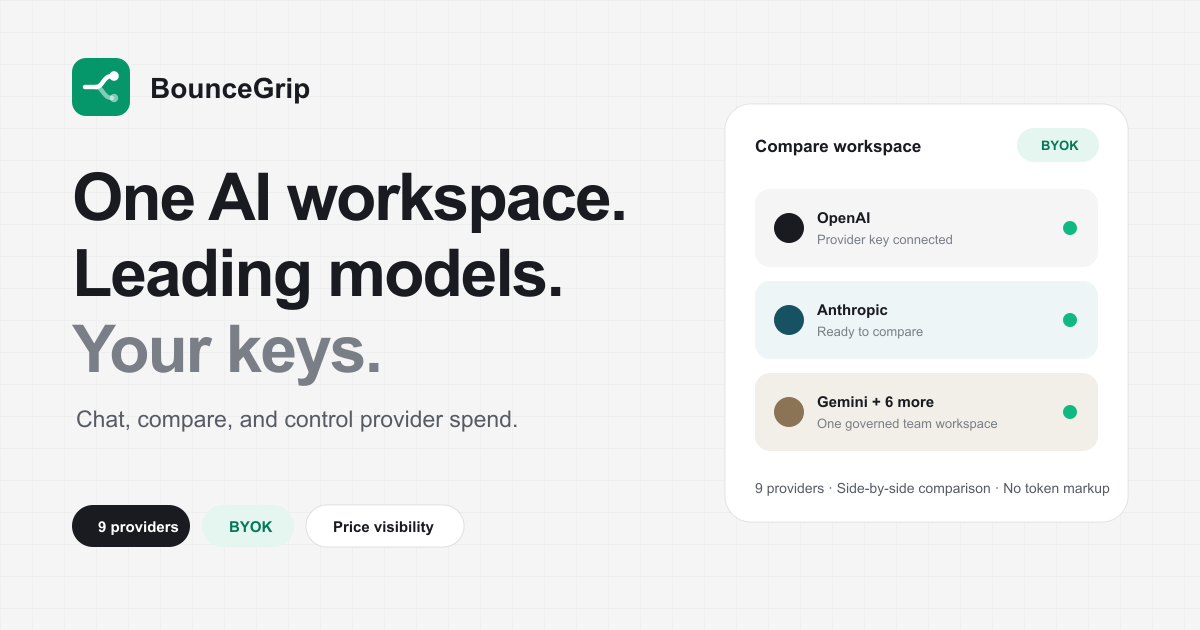
That is the point of a model-agnostic AI workspace. Instead of asking everyone to live inside one model brand, you give the team one workspace where OpenAI, Anthropic, Google Gemini, OpenRouter, DeepSeek, Kimi, Qwen, MiniMax, GLM, xAI (Grok), and Meta (Muse Spark) can sit side by side. People can chat, compare responses, bring files into context, save useful outputs, and track token usage with available cost estimates.
BounceGrip was built around that idea. It is not trying to convince you that one model is always the winner. It is built for the messier reality: some tasks need a frontier model, many tasks do not, and the lowest-cost model that meets your quality bar changes faster than most internal tool policies can keep up.
Quick answer
What should you do?
A model-agnostic workspace cuts LLM costs by making model comparison, direct provider billing, and reusable team workflows part of the same daily habit.
The problem with choosing one AI model
Single-model standardization feels tidy on a procurement spreadsheet. Everyone gets the same tool, the same login, the same training material, and the same vendor invoice. For a week or two, that can feel like progress. Then the real work starts. A product marketer wants a stronger writing model. An analyst wants longer context. A support lead wants cheaper bulk summarization. A founder wants to test a new model because it suddenly became better at reasoning.
The team is not being difficult. They are discovering that AI work is not one workload. Drafting a launch email, reviewing a contract, extracting themes from customer interviews, cleaning a CSV, and comparing product positioning are different jobs. They do not deserve the same default model just because that model won the last internal debate.
A model-agnostic workspace makes that tension easier to manage. It gives the team a stable place to work while letting the model layer stay flexible. Your workflow stays familiar. Your model choices can evolve.
Cost savings come from routing ordinary work away from expensive defaults
The fastest way to overspend on AI is to use your strongest model for everything. It is the equivalent of sending every office errand by private courier. Sometimes you need the best. Often you need good enough, fast enough, and cheap enough.
A practical model-agnostic setup lets teams reserve frontier models for the jobs that earn them. Deep reasoning, complex synthesis, and high-stakes writing may deserve the premium option. Routine summarization, first drafts, internal rewrites, categorization, light research cleanup, and simple Q&A often run perfectly well on less expensive models.
That is where the savings become real. You are not telling people to use worse AI. You are giving them a workspace where cheaper capable models are visible, usable, and easy to compare. The moment the lower-cost answer is good enough, the team keeps the difference.
BYOK keeps the economics honest
A lot of AI tools hide the actual model cost behind a subscription, credit bundle, or usage markup. That can be convenient, but it makes cost control harder. If you cannot see the provider price, you cannot tell whether a workflow is expensive because the model is expensive, because the tool adds a margin, or because the team is using the wrong model for the job.
BounceGrip uses a bring-your-own-key model. Owners connect provider API keys once, keys are encrypted at rest, and members can use approved models without seeing the keys. The subscription covers the workspace. Model usage is billed by your providers at their prices.
That matters because the incentive is clean. BounceGrip does not need you to burn more tokens to make more token margin. The product is useful when it helps your team get better answers, compare model quality, and move more work to lower-cost models without losing confidence.
Model comparison turns opinion into evidence
Most model debates are oddly emotional. Someone had a great result in Claude. Someone else swears GPT is better for structured thinking. Another teammate got a surprisingly good answer from a cheaper open model. Everyone is telling the truth, but nobody is looking at the same prompt, the same context, and the same output side by side.
Comparison changes the conversation. In BounceGrip, a team can run one prompt across up to four models and look at the answers next to each other with available price estimates. The best answer is no longer a vibe. It is something you can inspect.
This is especially useful for recurring work. If your support summaries are consistently good on a cheaper model, make that the default for the workflow. If board memo drafts need a stronger model, keep it there. The point is not to crown one winner. The point is to build a living map of which model earns which task.
A shared workspace protects the team from tool sprawl
Without a shared workspace, AI adoption gets messy fast. One person uses a personal ChatGPT plan. Another keeps prompts in a notes app. A third pastes customer research into three different tools to see what happens. Useful outputs disappear into private chats. Nobody knows what the team spent, which model produced the best answer, or where the latest prompt lives.
A model-agnostic workspace does not just connect models. It gives the work a home. Prompts can be saved and shared. Files can be attached to projects. Strong outputs can be kept next to the context that produced them. Usage can be reviewed by model, provider, member, and project.
That is the quiet operational benefit. The team gets freedom at the model layer without chaos at the workflow layer.
Governance gets simpler when owners control access once
BYOK should not mean everyone gets a spreadsheet full of API keys. In a serious team setup, key ownership and model access need to be separated. Owners should decide which providers are connected, which models are enabled, and who can use them. Members should be able to do the work without handling secrets.
BounceGrip is designed around that split. Owners manage keys and model access at the workspace level. Members use the enabled models through the app. Keys stay encrypted and server-side. That gives teams a more practical path than asking every teammate to create provider accounts, manage billing, and paste keys into local tools.
The result is more control with less ceremony. You can expand model choice without expanding the number of people touching sensitive credentials.
The best model will keep changing
AI model quality is not static. A model that looked unbeatable in January can feel average by April. A cheaper provider can suddenly ship a strong reasoning model. A frontier provider can raise or lower prices. Context windows change. Tool use improves. A model that is weak for one domain may be excellent for another.
That pace punishes teams that build their workflow around one logo. Every switch becomes a migration. Every new model becomes a training problem. Every pricing change becomes a budgeting surprise.
A model-agnostic workspace gives you a more durable operating system. The workspace, projects, prompts, saved outputs, and team permissions stay stable. The model lineup can change underneath it. You are buying adaptability, not just access.
What to look for in a model-agnostic AI workspace
Not every multi-model tool solves the same problem. Some bundle models behind credits. Some are built for a single department. Some give you model choice but weak visibility into spend. If cost savings and flexibility are the goal, look for the pieces that change daily behavior.
- Transparent price contextPeople make better choices when available cost estimates are visible before the habit forms.
- Side-by-side comparisonThe team needs a way to test quality on the exact prompt they are about to use.
- Bring-your-own-key billingDirect provider billing keeps token economics understandable and avoids hidden markups.
- Workspace-level key controlOwners should manage access once while members use approved models safely.
- Shared prompts and project contextCost savings matter more when the workflow itself becomes repeatable.
Where BounceGrip fits
BounceGrip is for founders and small teams that want the upside of the AI model race without rebuilding their workspace every time the leaderboard changes. It gives the team one place to chat, compare, work with files, manage prompts, save outputs, and understand usage.
The core promise is simple: bring your keys, choose your providers, and stop paying premium-model prices for work that a cheaper capable model can handle. Use the strongest model when it matters. Use the efficient model when it is enough. Keep the savings because the token bill belongs to your provider account, not a marked-up middle layer.
If your team is already using AI every day, model agnosticism is not a luxury feature. It is how you keep quality high, costs legible, and your options open.
How we prepared this guide
BounceGrip builds a BYOK AI workspace, so our perspective is explicitly for teams that value model choice, direct provider billing, and shared workflow context. We make that point of view visible rather than presenting it as a universal answer.
- Experience: the guidance is shaped by the product problems this workspace is built to solve.
- Verification: time-sensitive claims are linked to the relevant first-party source below.
- Scope: this is a decision guide, not legal, security, or financial advice; validate fit against your own requirements.
Last reviewed .
Sources and verification
Product and pricing details can change. We link to first-party documentation where available and reviewed these sources when this article was last updated.